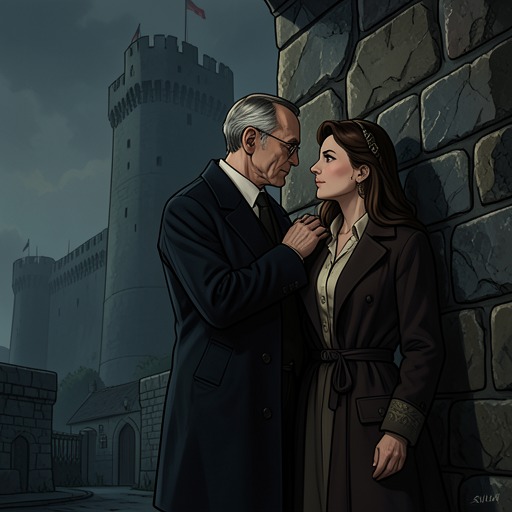
Goldmund’s trysts with Agnes and his arrest
Narcissus and GoldmundGoldmund’s trysts with Agnes and his arrest transform a clandestine affair into a near-fatal collision between desire and the governor’s authority. Goldmund pursues Agnes, the governor’s mistress, and accepts the danger of entering the castle to meet her; when the rendezvous is discovered, the count labels him a thief and condemns him to hang. The rescue comes through Narcissus, whose intervention secures a pardon—but, as Goldmund later learns, at a political price.
Pursuit and the secret invitation
Goldmund’s interest in Agnes begins as an open, wordless challenge. For two days he appears wherever she rides or goes in the city, meeting her gaze and making no secret of his admiration. Agnes answers with a smile that turns the pursuit into a contest between them. Goldmund also notices the governor, Count Heinrich: imposing, but older and troubled-looking. The contrast feeds Goldmund’s sense that he can challenge the man who possesses the woman he desires.
Agnes makes the next move on the third morning. She sends her groom away, rides alone beyond the bridge, and waits for Goldmund on the road to the pilgrims’ shrine of St. Vitus. Once he has joined her, she gives him a chain and precise instructions for entering the castle that evening. He is to present himself as a beggar who has found it, keep it in his own hands, and insist on delivering it directly to her. She names the stable groom Max and her chambermaid Berta as the only servants she trusts, warns him to treat the others—including the count—as enemies, and makes clear that the plan could cost him his life.
The invitation renews Goldmund’s sense of being alive. His recent misery seems to fall away like a yellow leaf, and Agnes’s height and blond vitality recall the image of his mother that he carried as a boy at Mariabronn. The danger is not incidental to the attraction: Goldmund welcomes the prospect of staking his freedom and existence on this encounter.
The rendezvous and discovery
At the castle, Goldmund waits until Agnes can come to him. She appears in a light blue dress edged with white fur and tells him that the count is occupied at dinner with church officials. In her brightly lit bedchamber, a meal has been laid out: bread and butter, meat, white wine in a bluish glass, and a shared chalice. Their first kiss gives way to intimacy; the prepared meal and the risk of discovery make the room both a private refuge and a precarious one.
Their mood changes when a nearby door slams and rapid footsteps approach. Agnes recognizes the danger and pushes Goldmund into a closet room, telling him to escape through it and not betray her. The way out proves to be locked from the corridor. Alone among the dresses in darkness, Goldmund understands that he may have been seen entering and that he is trapped. He steadies himself by resolving not to betray Agnes, even as the possibility of death becomes immediate.
The count confronts him and frames the encounter as theft. He asks whether Goldmund is a city burgher; Goldmund answers that he is homeless and poor. The count then dismisses the question of whether Goldmund has molested Agnes on the ground that he will be hanged anyway, declaring theft sufficient. When the door is opened, three footmen stand ready with drawn blades. The count orders them to bind the supposed vagrant, put him in the dungeon, and hang him the following morning.
Condemnation, pardon, and political price
Goldmund makes no resistance as he is led through the castle and down to a cellar. Before he is confined, two visiting priests encounter the guards. On learning that the prisoner has been condemned to death without a confessor, one priest insists that Goldmund is still entitled to confession and the sacraments, and obtains the guards’ promise that he will not be taken away before the priest can see him. The episode places a basic religious entitlement against the count’s swift use of punitive authority: even a man branded a thief is not to be denied the rites due to a Christian.
Narcissus, now an abbot, arrives with the news that Goldmund has been pardoned and that he has come to take him away. Goldmund first tells his old friend that he has been sentenced to hang and has little time left, maintaining a cool, almost casual manner. Narcissus understands that this bravado protects Goldmund’s pride. Their long handshake carries the feeling their brittle banter avoids, and Goldmund agrees to leave with him for Mariabronn.
The pardon does not mean the affair was harmless or that the count simply relented. Narcissus explains that he had been in the governor’s palace as one of the delegates negotiating between the Emperor and the religious order, though the negotiations had achieved little. Goldmund is not told that Narcissus secured his life by conceding points to the ruthless count. When Goldmund explains that he had gone to meet the count’s mistress and wonders why the count let him go, Narcissus replies that the count was capable of bargaining. The rescue is therefore at once an act of friendship and a political transaction.
Consequences and significance
Goldmund leaves the city in poor physical condition. He tires in the saddle, cannot keep hold of the reins, and spends a night in a village with a slight fever; his hands heal as he recovers. On the road, he returns to lively conversation, pressing Narcissus with questions. The movement from a locked closet and a death sentence to renewed travel with his friend closes the immediate crisis without erasing its cost: his survival depends on another person’s intervention and on negotiations conducted beyond his knowledge.
The episode’s central reversal is that a secret love affair is converted into a public criminal charge. The count uses the language of theft to justify a sentence that also neutralizes the danger of Goldmund’s encounter with Agnes. Against that authority, the priest’s insistence on sacramental rights offers a limited procedural safeguard, while Narcissus’s pardon demonstrates that formal judgment can be altered by political bargaining. Goldmund’s peril is thus not only romantic adventure: it exposes how desire, legal accusation, church privilege, and political power converge around a single vulnerable wanderer.